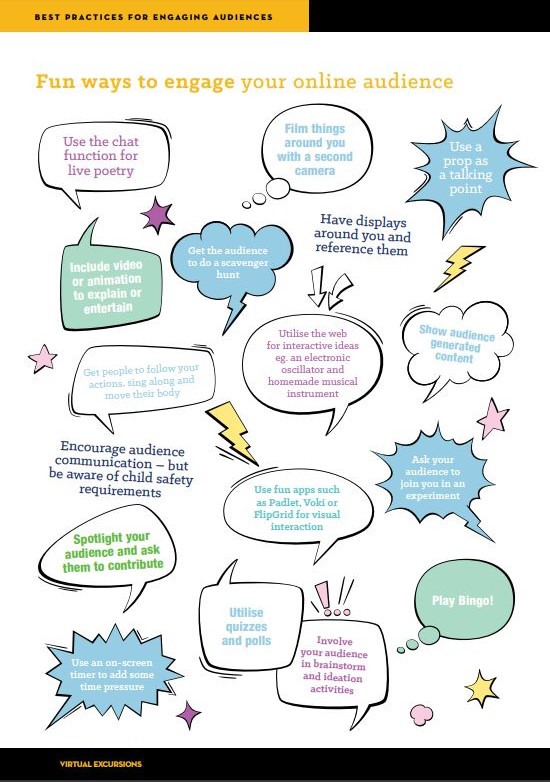
Discover some great ideas to engage your audience online. Remember engaging event involves more than watching a talking head. Plan ahead, know your audience and what you are trying to achieve. Use your passion and content knowledge to get the best out of your programs. Make the most of your resources and props and don’t forget to use these fun engagement ideas.
Fun ways to engage audiences online Heather Catchpole from Refaction Media
The Virtual Excursions training package has been coordinated for national delivery by Inspiring Australia NSW. It was produced and delivered by Fizzics Education, Sydney Science Education and Refraction Media with support from the NSW Office of the Chief Scientist & Engineer and state Inspiring Australia programs in NSW, ACT, QLD, WA and SA.
Australian National Maritime Museum is hosting a Pirate School for young pirate recruits. Learn how to become a pirate with the museum’s own resident pirate Grognose Johnny – he’s even set some homework activities for the young sea squirts!
Explore our newly developed series of online resources for students, teachers and parents, to help guide students’ learning while they’re away from the classroom. With subjects suitable for Early, Primary and Secondary learners, these resources have been created to engage students and guide further activity on the topics.
We will be continually adding to this page in the coming months as we create more immersive learning opportunities for students at home.
Whilst understanding how to use a camera and microphone during a live online program is essential, choosing additional content to interact with can make all the difference to the engagement of your audience. Thankfully many of the web conferencing tools have screen sharing capability, which means that you can share extra content that both help support your lesson and breaks up the monotony of a constant video of you as a ‘talking head’!
The following only briefly touches on the huge variety of options to things to share on-screen, as in reality what you can share is only limited by your creativity. What’s more, as long as you control the child safety aspects of your meeting, you can also have your attendees share their screen too which means the interactivity increases even further.
Whiteboard sharing for the win
A screen capture from full desktop sharing of Adobe Photoshop – Fizzics Education
Many of the web conferencing software have a whiteboard function. This means you can quickly draw on diagrams on the fly as you speak to them. There is even the option in some cases for multiple people to be able to draw onto the whiteboard at the same time. If your conferencing software doesn’t have a whiteboard function, you can screen share Microsoft Paint, Adobe Photoshop and other applications which will produce the same effect. You can also save the images and share them afterwards too!
Connect peripheral devices to share
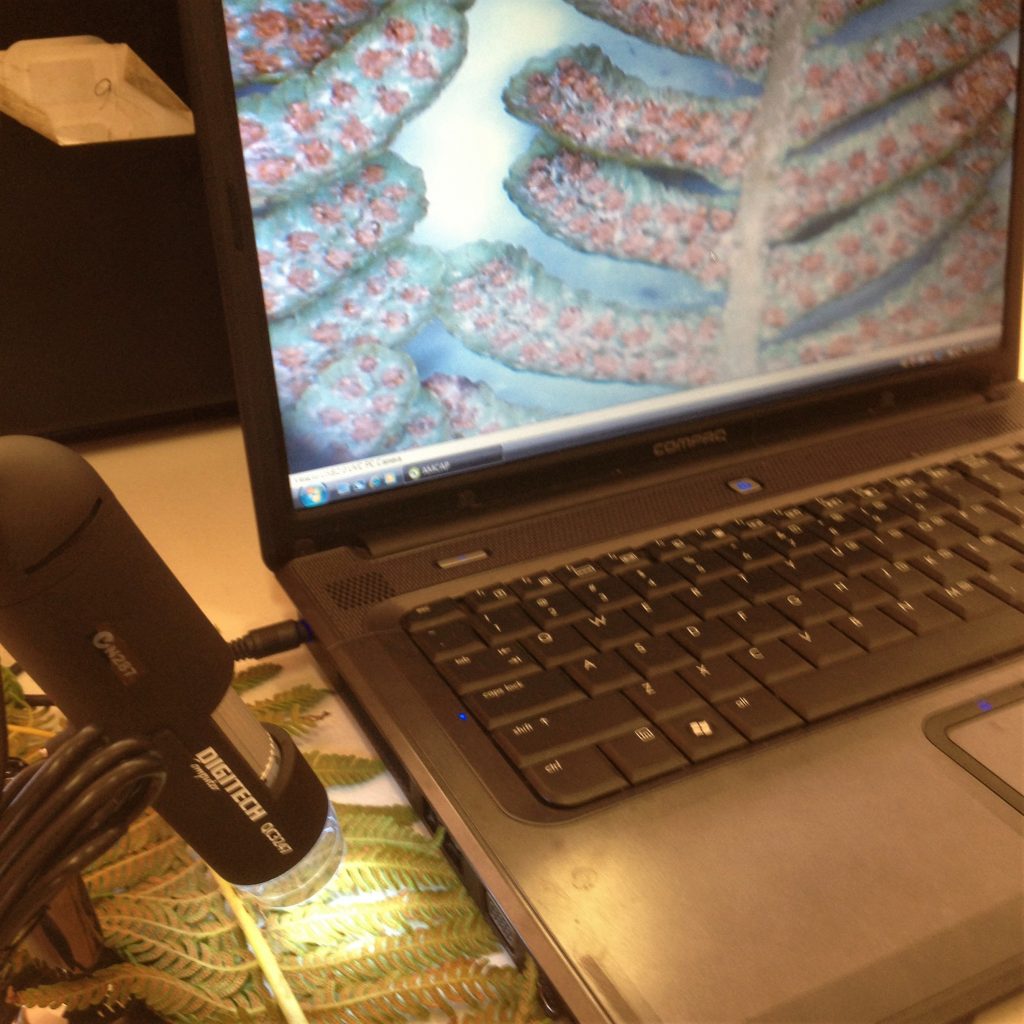
Using a USB Digital Microscope to look underneath a fern – Fizzics Education
Your peripheral devices that you routinely use might well be fascinating to your remote audience! For example, not everyone can get USB powered digital microscopes easily. Why not share their images live? Simply power-up your digital microscope and then screen share the results! If you do some testing, sometimes you can find that the digital microscope camera is recognised by the web conferencing app itself, which means you can simply toggle between your camera and the microscope. There are also converters which allow your analogue microscope to share the images digitally too, a great way to microscopic organisms in more detail. Think about what device you have at your site that could be shared during your conference.
Use data logging live in your conference
Wouldn’t it be great to share live experiment results? Well, with screen sharing you can! There are plenty of data logging apps out there that you can be shared over a remote connection. One of the ones that Fizzics Education uses is Science Journal. It’s a data logging app by Google that uses the sensors in your smartphone or tablet to perform experiments! Record sound levels, magnetism, light levels, acceleration and much more. Very handy for your remote audience to see measurements in real-time of your experiment, plus you can pull the data file and share it to your audience either during the conference or afterwards as well.
Connect people together by sharing
Remote connections can often feel like a barrier for sharing experiences. Why not consider having your audience share what they are experiencing from their location? In early April 2020, Fizzics Education organised a Supermoon party, where people from Japan, the Philippines and Australia all were involved in sharing what they were seeing live during the event. Because of timezone differences, people were able to see that not all of us were able to experience the Supermoon rise at the same time, plus it opened up a chance to discuss about different cultures & locations as well.
Use visual apps that enrich your live content There are so many science apps available these days! If you connect your device to your web conference, there is no reason why you can’t share some of this content if it is already available for free. You can share virtual skies, explore the human body, play science games and more! As long as your app fits well within your conference, we say go for it!
These were just some brief ways that you can use screen sharing to enhance remote learning. Some extra tips to consider.
Only have the tabs open on your browser that you are happy to share! You may not wan to share everything that is on your desktop
To control what you share even further, only choose the application that you want to share instead of the whole screen.
Turn off desktop notifications & reminders that you might normally receive during the day
Be aware of internet bandwidth. If you are sharing a rich HD moving image, this may not show up as well for your remote audience if their internet is not high speed.
If you are sharing apps, have them preloaded and ready to go on the screen that you need.
If you use screen mirroring to your device, there is a lag in connecting to the conference that you will need to adjust for.
Practice and test! Make sure you know how connect to your extra content easily.
So, are you ready to give it a go? When it s comes down to it, it just a matter of thinking carefully about how the extra content impacts upon your overall presentation.With these tips and mind and little creativity, your remote audiences will love your line online programs!
Fizzics Education, Sydney Science Education and ANSTO are bringing you some great programs for World Environment Day 2020. World Environment Day is celebrated every 5th of June and the theme for 2020 is Celebrating Biodiversity.
5 June 2020
Fizzics Education: Renewable Energy
We will investigate various renewable energy sources and compare them against non-renewable energy sources. A focus will be placed upon how a generator actually works and how this is applied in coal power stations, wind farms, hydroelectric dams, tidal generators, etc. We’ll also discuss why switching to renewable energy sources will help reduce carbon emissions, with reference being made to the scientific basis of climate change.
No matter where you live across Australia there are plants and animals that live nearby. From our beaches to the mountains, the deserts to the rainforests and even in your backyard there is Biodiversity all around us. Join me to learn about some of these amazing habitats and the animals that live there.
Learn about some incredible animals, their adaptions to the habitat they live.
ANSTO: Saving Shorebirds and their Important Habitats
Shorebirds are rapidly declining in numbers and several species are now threatened with extinction. In Australia and elsewhere their shoreline habitats are being permanently affected by human activity or are disappearing altogether.
Join ANSTO on World Environment Day to explore the amazing journey of migratory shorebirds!
There have been some great collections of digital programs being complied from around the world. I wanted to create a list of Australian education providers and websites that have great resources. There are some great options to help your students and kids in class or at home.
ABC Education
ABC Education brings you thousands of free, curriculum-linked resources for Primary and Secondary students and teachers.
ABC TV Education broadcasts two hours of dedicated education programming for school aged viewers nationwide each weekday from 10am – 3pm on ABC ME.
Live Streams
Sea EagleCAM is a live remote feed operating out of the BirdLife Discovery Centre in the Armory at Sydney Olympic Park close to the Parramatta River.
Zoos Victoria is bringing the zoo to you with learning activities, resources, webinars and live stream animals to help with real-world learning, by distance. Check out the Zoo Education Online resources. Melbourne Zoo and Werribee Open Range Zoo have set up a live streams of enclosures online.
Taronga Zoo Sydney has set up 24/7 live-streaming cameras at so you can enjoy your favourite animals at any time of day.
Get up close with our animals from the comfort of your own home and discover more about WILD LIFE Sydney Zoo by watching our live streams below.
ReefCam is Australia’s first ever rocky-reef, live-feed, combined under and above water webcams. Discover species found in Port Phillip Bay including the underwater flora and fauna.
Fizzic Education has 150 Science Experiments online for FREE. Science experiments and project ideas using simple, low cost materials that teach science easily.
Cool Australia has FREE activities and resources that make teaching and understanding real world scenarios as easy as possible.
Australian Music Examinations Board Theory of Music online courses now FREE
TedED is producing high-quality, interactive, video-based lessons to help teaching and learning from home.
Virtual Field Trips
Here are 30+ great Virtual Field Trips for early learners to explore from your home on your couch. From zoos and landmarks to famous museums, you can explore the world with your child with over a month of virtual field trips
Interactive online programs
Interactive activities direct to your home through as Virtual Excursion. Fizzics Education, Sydney Science Education, REDed Dance and Chess Mates are all offering online school holiday programs.
Video Conferencing can be used to create unique learning experiences for students of all ages. Sydney Science Education offers a range of video conferences called Science Made Easy. Specialising in Earth and Environmental Science, Science Made Easy are hands on, interactive workshops designed to inspire your students about the natural world.
Since 2001, I have designed and delivered innovative programs for schools across New South Wales and Australia. Over the last 20 years I have become a leading expert on using digital technologies especially video conferencing to deliver quality learning experiences in schools.
Through these programs your students will gain insight into the importance of science and help them discover more about the natural world. Workshops are designed to empower your students and provide them with the knowledge and skills to continue their learning. Content will help increase your students scientific literacy and critical thinking skills by participating in experiments, fieldwork and asking questions.
Due to the current health crisis Video Conferencing becomes more important as a way to deliver programs to students in the classroom and at home.
https://youtu.be/CiDtyDzekw0
Find out how you can participate in live, interactive video conference sessions. This enables your students to ask questions and really be involved in their online learning.
There are a range of packages available to suit your digital science education needs. Enquires and bookings
Multi-award-winning virtual programs by Fizzics Education are available to all students to keep up student enthusiasm & enrichment in these unprecedented times. These virtual excursions are available to your school now, no matter your location across Australia and the world.
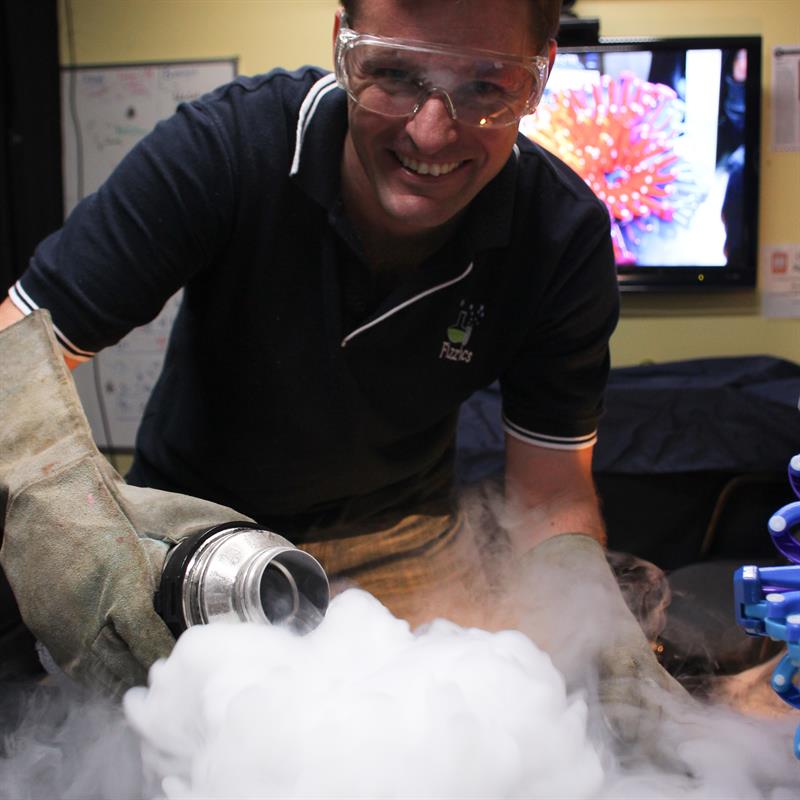
Liquid Nitrogen Video Conference
Fizzics Education has been running live virtual classes with students since 2011. Their programs are highly interactive distance lessons by highly experienced distance educators including:
Direct curriculum links
Live classes; students can question & answer our educators and participate in experiments using household materials
Pre, during and post virtual excursion lesson notes for both teachers and students.
A list of inexpensive materials that students can have on-hand during the lesson.
Option to use Flipgrid to help students discuss the content further
Simple connection, one click and you’re in!
All supported by over 150 FREE experiments, student podcasts and more
We know that this may not be part of your scope and sequence yet, however these virtual excursions are a direct solution for keeping students focused and connected with the online content that you are preparing.
Contact Fizzics Education now to find out more and secure your booking!
ClickFest is an annual video conferencing festival run in November each year. ClickFest is an exciting initiative from education organisations across Australia. It highlights the diversity and scope of video conferences available to schools across Australia. Sessions are delivered free or at reduced cost to schools, providing a great opportunity for teachers to give it a go.
Topics and programs will vary over the month long video conferencing festival to provide flexibility for teachers and students. Each day multiple sessions will be available on a variety of topics from content providers around Australia.
Time: 11.00
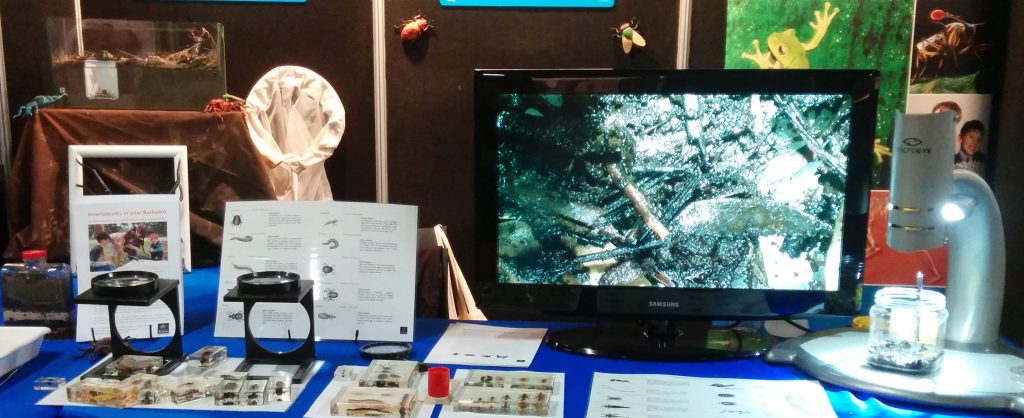
Overview: Minibeast Magnified explores the exciting and diverse world of invertebrates. Students will learn how to identify common groups of invertebrates and why they are important. The workshop is designed to provide information and skills that will enable you and your students to conduct an invertebrate survey in your school.
Time: 14:00
Overview: The Geology Rocks video conference will look at the dynamic earth forming processes. Students will learn about the layering of lava flows, see if rocks float and learn how to make a gas and find out about the rock cycle. You will also see real specimens and there will be opportunities to ask questions.
Overview: Australia has over 240 species of native amphibians, all of which are frogs. Frogs play a key role in many food webs, both as predators and as prey. By observing frog populations, we can get a good indication of the condition of the environment as frogs are sensitive to environmental change. At present, frog populations are declining all around the world.
Overview: Australia has over 240 species of native amphibians, all of which are frogs. Frogs play a key role in many food webs, both as predators and as prey. By observing frog populations, we can get a good indication of the condition of the environment as frogs are sensitive to environmental change. At present, frog populations are declining all around the world.
Overview: Don’t let your students miss out on this special opportunity to go back to the 1880s for a ‘lesson from the past’ in this live event at Rouse Hill Schoolhouse. The Schoolhouse was built in the 1880s and is set up as it would have looked when it was 19th century classroom. The students will meet their 1880s schoolmistress, Miss Fox, and participate a typical 19th century lesson based on the syllabus of the time. The class will sing the national anthem, God Save the Queen and the lesson will include elocution, arithmetic using an abacas and a drawing session.
Overview: The Geology Rocks video conference will look at the dynamic earth forming processes. Students will learn about the layering of lava flows, see if rocks float and learn how to make a gas and find out about the rock cycle. You will also see real specimens and there will be opportunities to ask questions.
Overview: Fossils are fascinating reminders of life in ancient times and provide a window into the past. They can also reveal an amazing amount of information about extinct species and the ancient world. Step inside the shoes of a palaeontologist to use fossil material and modern animals to reconstruct some extinct Australian animals.11
Overview: Fossils are fascinating reminders of life in ancient times and provide a window into the past. They can also reveal an amazing amount of information about extinct species and the ancient world. Step inside the shoes of a paleontologist to use fossil material and modern animals to reconstruct some extinct Australian animals.11
Overview: Minibeast Magnified explores the exciting and diverse world of invertebrates. Students will learn how to identify common groups of invertebrates and why they are important. The workshop is designed to provide information and skills that will enable you and your students to conduct an invertebrate survey in your school.
Time: 14:00
Overview: Australia has over 240 species of native amphibians, all of which are frogs. Frogs play a key role in many food webs, both as predators and as prey. By observing frog populations, we can get a good indication of the condition of the environment as frogs are sensitive to environmental change. At present, frog populations are declining all around the world.
Earth Science Week 2017 is on soon. Join in from October 8-14, 2017 and celebrate the theme “Earth and Human Activity.” This year’s event, the 20th annual Earth Science Week celebration, promotes awareness of what geoscience tells us about human interaction with the planet’s natural systems and processes.
Earth Science Week – Fascinating Fossils
Time: 10:00
Fossils are fascinating reminders of life in ancient times and provide a window into the past. They can also reveal an amazing amount of information about extinct species and the ancient world. Step inside the shoes of a palaeontologist to use fossil material and modern animals to reconstruct some extinct Australian animals.
Earth Science Week – Fascinating Fossils
Time: 11:00
Fossils are fascinating reminders of life in ancient times and provide a window into the past. They can also reveal an amazing amount of information about extinct species and the ancient world. Step inside the shoes of a palaeontologist to use fossil material and modern animals to reconstruct some extinct Australian animals.11
Earth Science Week – Geology Rocks
Time: 13:00
The Geology Rocks video conference will look at the dynamic earth forming processes. Students will learn about the layering of lava flows, see if rocks float and learn how to make a gas and find out about the rock cycle. You will also see real specimens and there will be opportunities to ask questions.
Earth Science Week – Geology Rocks
Time: 14:00
The Geology Rocks video conference will look at the dynamic earth forming processes. Students will learn about the layering of lava flows, see if rocks float and learn how to make a gas and find out about the rock cycle. You will also see real specimens and there will be opportunities to ask questions.
Thursday 12 October
Earth Science Week – Geology Rocks
Time: 10:00
The Geology Rocks video conference will look at the dynamic earth forming processes. Students will learn about the layering of lava flows, see if rocks float and learn how to make a gas and find out about the rock cycle. You will also see real specimens and there will be opportunities to ask questions.
Earth Science Week – Geology Rocks
Time: 11:00
The Geology Rocks video conference will look at the dynamic earth forming processes. Students will learn about the layering of lava flows, see if rocks float and learn how to make a gas and find out about the rock cycle. You will also see real specimens and there will be opportunities to ask questions.
Earth Science Week – Fascinating Fossils
Time: 13:00
Fossils are fascinating reminders of life in ancient times and provide a window into the past. They can also reveal an amazing amount of information about extinct species and the ancient world. Step inside the shoes of a palaeontologist to use fossil material and modern animals to reconstruct some extinct Australian animals.
Earth Science Week – Fascinating Fossils
Time: 14:00
Fossils are fascinating reminders of life in ancient times and provide a window into the past. They can also reveal an amazing amount of information about extinct species and the ancient world. Step inside the shoes of a palaeontologist to use fossil material and modern animals to reconstruct some extinct Australian animals.
The SciFest video conferencing festival is in August and provides a great link to National Science Week. Now in it’s fouth year SciFest is a great opportunity to engage your students in a variety of science workshops and events.
Overview: Lloyd Godson is an ambassador for ocean exploration committed to encouraging more young Australians to undertake STEM (science, technology, engineering and maths) studies and careers. He is also no stranger to marine expeditions. He has spent a total of one month living underwater, propelled himself through the Greek islands in a human-powered submarine and holds the Guinness World Records for the most electricity generated by pedalling underwater.
Tuesday 15 August
SciFest: Great Moments in Science with Dr Karl Time: 09:30 Overview: Join Australia’s science legend Dr Karl for a whirlwind of scientific explanations and bizarre facts. If you like science dished up with a big serving of humour then don’t miss this opportunity to see Dr Karl live! Get the scoop on the latest research and discoveries.
Overview: Minibeast Magnified explores the exciting and diverse world of invertebrates. Students will learn how to identify common groups of invertebrates and why they are important. The workshop is designed to provide information and skills that will enable you and your students to conduct an invertebrate survey in your school.
SciFest – Minibeast Magnified Time: 11:00 Overview: Minibeast Magnified explores the exciting and diverse world of invertebrates. Students will learn how to identify common groups of invertebrates and why they are important. The workshop is designed to provide information and skills that will enable you and your students to conduct an invertebrate survey in your school.
SciFest – Geology Rocks Time: 13:00 Overview: The Geology Rocks video conference will look at the dynamic earth forming processes. Students will learn about the layering of lava flows, see if rocks float and learn how to make a gas and find out about the rock cycle. You will also see real specimens and there will be opportunities to ask questions.
SciFest – Geology Rocks Time: 14:00 Overview: The Geology Rocks video conference will look at the dynamic earth forming processes. Students will learn about the layering of lava flows, see if rocks float and learn how to make a gas and find out about the rock cycle. You will also see real specimens and there will be opportunities to ask questions.
Thursday 24 August
SciFest – Fantastic Frogs Time: 13:00 Overview: Australia has around 200 species of native amphibians, all of which are frogs. Frogs play a key role in many food webs, both as predators and as prey. By observing frog populations, we can get a good indication of the condition of the environment as frogs are sensitive to environmental change. At present, frog populations are declining all around the world.
SciFest – Fantastic Frogs Time: 14:00 Overview: Australia has around 200 species of native amphibians, all of which are frogs. Frogs play a key role in many food webs, both as predators and as prey. By observing frog populations, we can get a good indication of the condition of the environment as frogs are sensitive to environmental change. At present, frog populations are declining all around the world.
Wednesday 30 August
SciFest – Minibeast Magnified Time: 09:30 Overview: Minibeast Magnified explores the exciting and diverse world of invertebrates. Students will learn how to identify common groups of invertebrates and why they are important. The workshop is designed to provide information and skills that will enable you and your students to conduct an invertebrate survey in your school.
SciFest – Minibeast Magnified Time: 10:30 Overview: Minibeast Magnified explores the exciting and diverse world of invertebrates. Students will learn how to identify common groups of invertebrates and why they are important. The workshop is designed to provide information and skills that will enable you and your students to conduct an invertebrate survey in your school.
SciFest – Geology Rocks Time: 13:00 Overview: The Geology Rocks video conference will look at the dynamic earth forming processes. Students will learn about the layering of lava flows, see if rocks float and learn how to make a gas and find out about the rock cycle. You will also see real specimens and there will be opportunities to ask questions.
SciFest – Geology Rocks Time: 14:00 Overview: The Geology Rocks video conference will look at the dynamic earth forming processes. Students will learn about the layering of lava flows, see if rocks float and learn how to make a gas and find out about the rock cycle. You will also see real specimens and there will be opportunities to ask questions.
Thursday 24 August
SciFest – Fantastic Frogs Time: 13:00 Overview: Australia has around 200 species of native amphibians, all of which are frogs. Frogs play a key role in many food webs, both as predators and as prey. By observing frog populations, we can get a good indication of the condition of the environment as frogs are sensitive to environmental change. At present, frog populations are declining all around the world.
. SciFest – Fantastic Frogs Time: 14:00 Overview: Australia has around 200 species of native amphibians, all of which are frogs. Frogs play a key role in many food webs, both as predators and as prey. By observing frog populations, we can get a good indication of the condition of the environment as frogs are sensitive to environmental change. At present, frog populations are declining all around the world.